Every software company owner is asking the same question right now: if AI can write a CRUD screen, a test or a simple fix in minutes, why keep hiring juniors who need half a year of coaching? "AI will replace them" sounds tempting – lower payroll, no onboarding. But the data and the experience of large companies suggest it is a short-sighted bet. Let's look at what is actually happening in the market and what to do about it in your own team.
What is happening in the job market
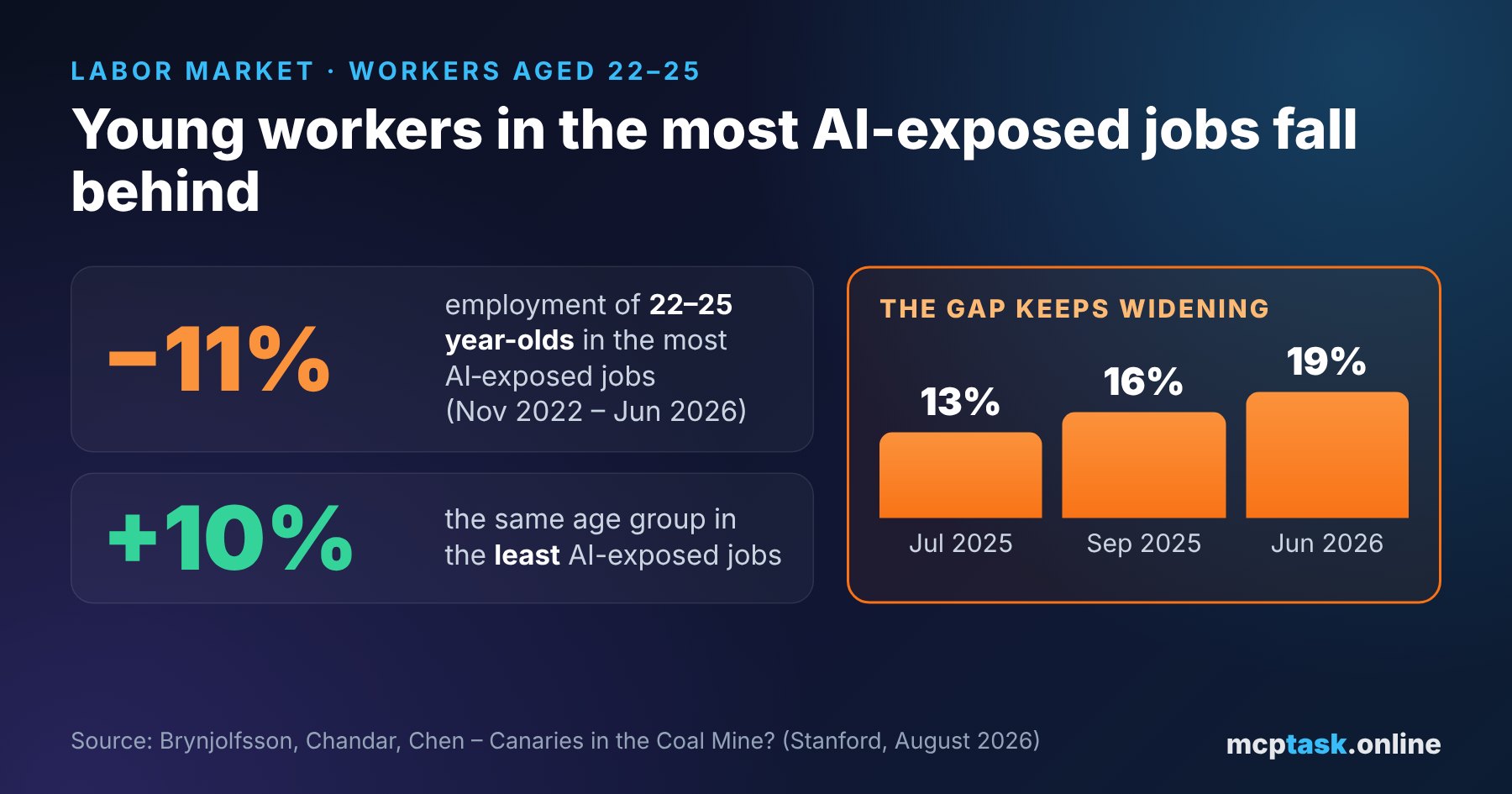
The most cited source is "Canaries in the Coal Mine?" by Erik Brynjolfsson, Bharat Chandar and Ruyu Chen of the Stanford Digital Economy Lab, built on ADP payroll data. Its August 2026 update reports that employment of workers aged 22–25 in the two groups of occupations most exposed to AI fell by about 11% between November 2022 and June 2026. The same age group in the least AI-exposed occupations grew by about 10% over the same period.
Put differently, employment of young workers in exposed occupations is now 19% below where it would be had it kept pace with their peers in less-exposed jobs. Experienced workers show no comparable gap. And the gap is widening: it was 13% in the July 2025 data, 16% in September 2025 and 19% by June 2026.
According to the authors, software developers sit in the most exposed group: they see large declines for early-career workers (22–25) and growth for older age groups. Two points from the study matter most for a manager:
- The gap comes mainly from hiring, not from layoffs. Companies simply stopped opening the door to newcomers.
- The declines are concentrated in occupations where AI substitutes for (automates) human work. Where AI complements people, employment is flat or rising.
The authors themselves call the results early, descriptive indicators rather than causal estimates. Still, the direction is clear: the market is moving from "hire a junior for the simple tasks" to "a machine does the simple tasks".
Who gains the most from AI in development
Here is the paradox. Field experiments with the GitHub Copilot assistant, led by Mert Demirer of MIT with colleagues from Princeton, the University of Pennsylvania and Microsoft, ran inside real companies – Microsoft, Accenture and an unnamed Fortune 100 firm. Access to the tool raised the number of completed tasks per week by 26% on average. But the biggest gains went to recent hires and junior developers: 27% to 39%. Senior developers gained only 8% to 13%. Newcomers were also more likely to adopt the tool.
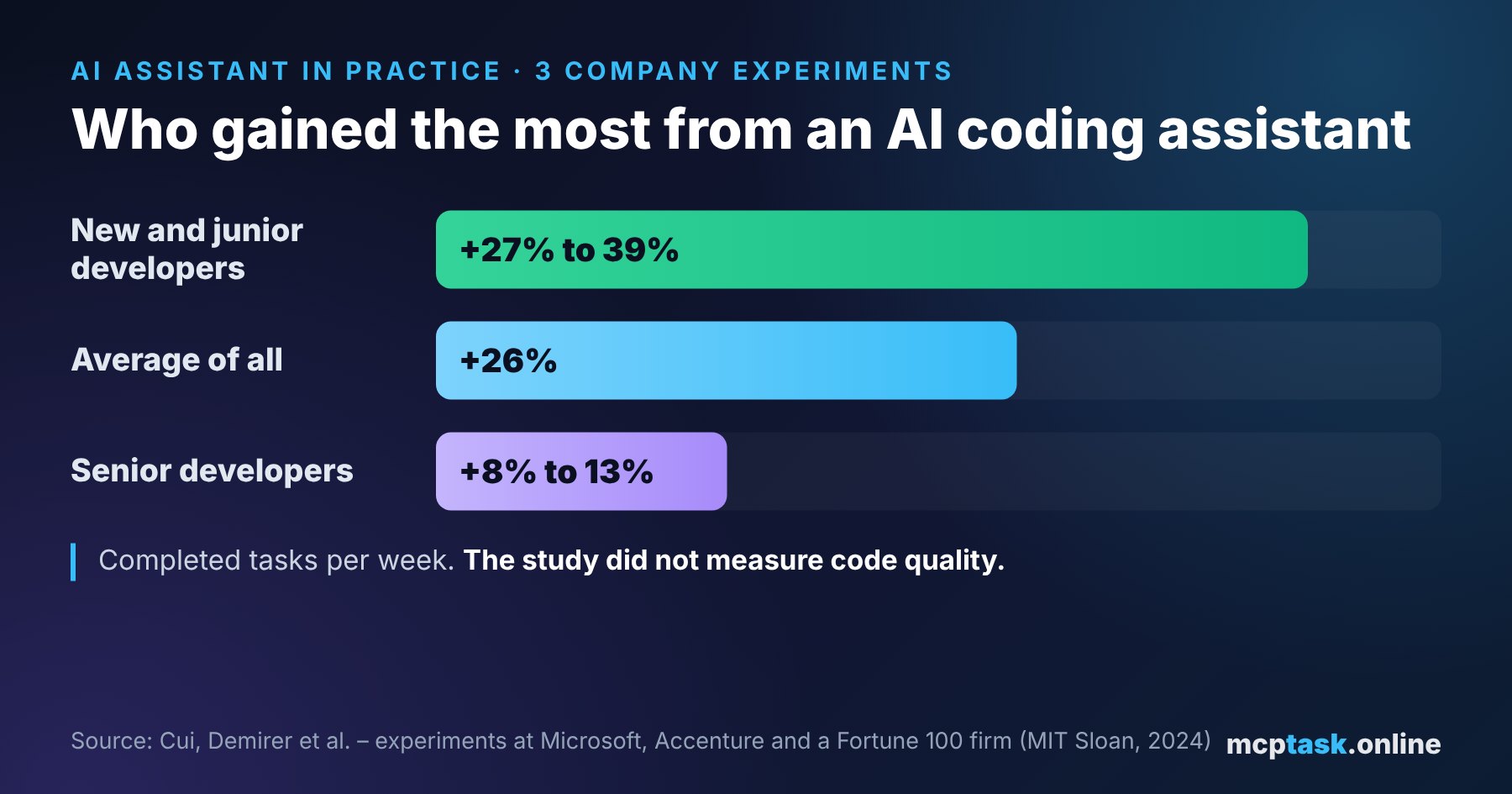
So a junior with AI is not redundant – it is the person AI helps the most. There is a catch, though: the study measured output, and it could not measure code quality. A junior with AI produces more code, but someone has to judge whether it is any good.
METR's research is another reason to distrust gut feeling. In its 2025 study, experienced open-source developers took 19% longer on tasks when AI was allowed – while estimating afterwards that AI had sped them up by about 20%. In a February 2026 update, METR says developers are likely faster with AI tools now, but its data is only very weak evidence for the size of that improvement. The lesson for a manager: measure the effect of AI in your own team instead of relying on impressions.
Why you should keep hiring juniors
In August 2025, AWS CEO Matt Garman called the idea of replacing junior staff with AI "the dumbest thing I've ever heard". His reasons are business reasons, not sentiment: juniors are probably the least expensive employees you have, they are among the most engaged with AI tools – and above all, how is it going to work ten years from now when no one in the company has learned anything? Companies, he said, should keep hiring graduates and teaching them how to build software, decompose problems and think about them.
Mike Loukides of O'Reilly takes the argument further: if you eliminate junior developers, where will the seniors come from? A few years down the road, when today's seniors retire, there will be no one to take their place. The path to a senior role runs through learning by doing, and it has to exist in the age of AI too. What changes is the content of the job: juniors need to become skilled debuggers, learn design, and think one level above the function they are writing. Using AI effectively is itself a skill they have to learn.
The practical conclusion for a software company: stop hiring juniors today and you save a few salaries, but in three to five years you will be overpaying for seniors in a market that has even fewer of them.
How to split work between AI, juniors and seniors
The sensible model is not "AI instead of a junior" but a new division of labor:
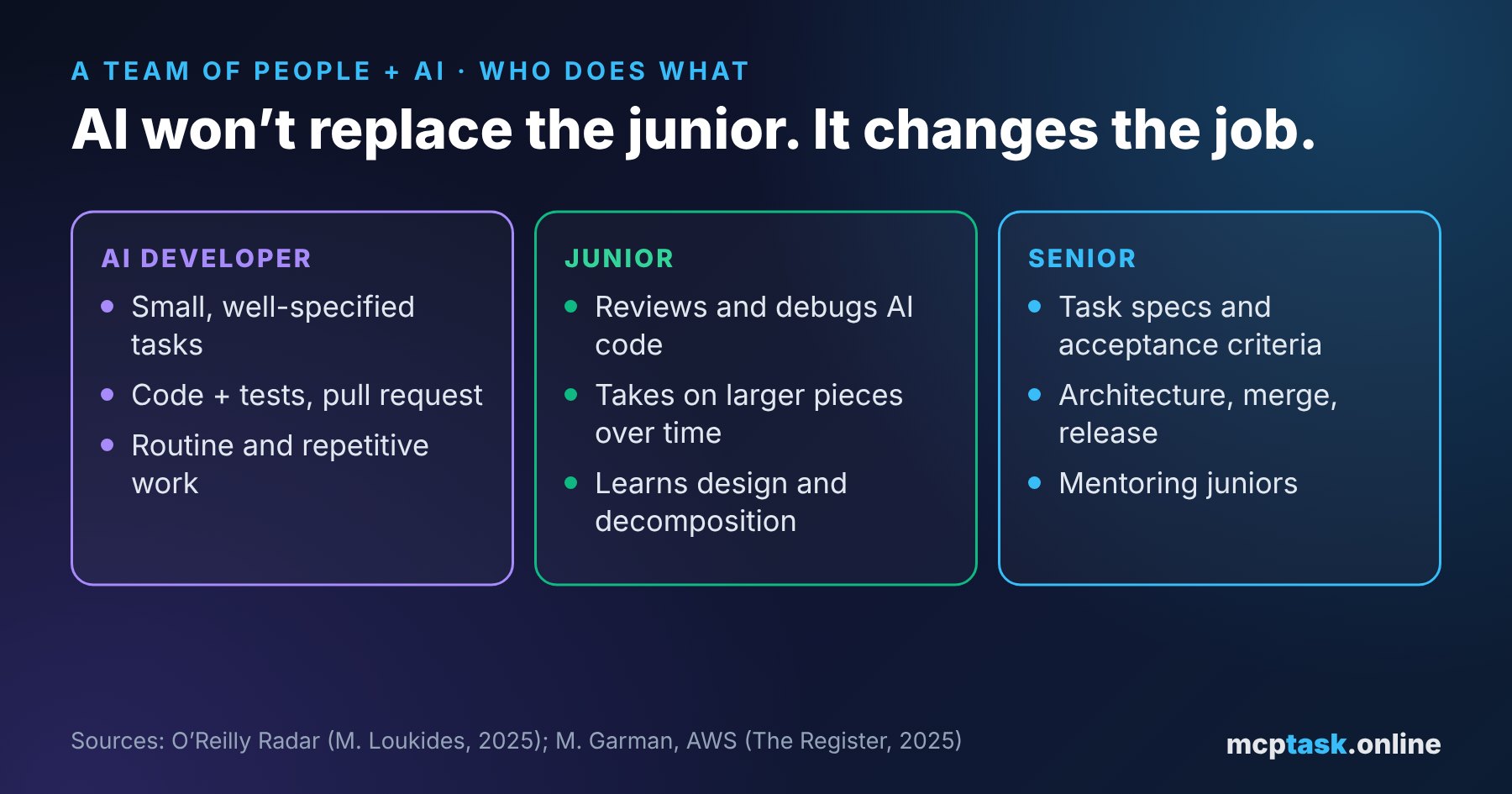
- Give routine work to AI. Small, well-specified tasks with acceptance criteria – fixes, form changes, tests, refactoring along an existing pattern. This is where AI saves the most time.
- Put juniors on review and debugging. Reading someone else's code, finding bugs and checking it against the spec is exactly the skill O'Reilly says they need. AI-written code is ideal practice material.
- Give juniors larger pieces over time. Not just "the small tasks that are left" – AI does those now. Juniors need work where they learn design and problem decomposition, with a senior's support.
- Seniors write the specs and guard quality. A well-scoped task with clear criteria is now a senior's most valuable output – both juniors and AI benefit from it.
- Measure outcomes, not feelings. Track how many tasks get finished, how many come back from review and how much time they really cost – separately for people and for AI.
How mcptask.online helps
mcptask.online is task management for people and autonomous AI developers on one team. You break a project into Epic → Story → Task, give tasks a priority, scrum points (which automatically produce an hour estimate) and dependencies as real blocker links. A senior prepares a queue of well-described tasks that both people and AI pull work from.
The autonomous AI developer (the runner) works on your own infrastructure, with the model of your choice. It picks tasks from the queue by priority, writes the code and tests, and opens a pull request. In manual mode the PR stays open for human review – ideal work for a junior under a senior's eye. A person decides on merge and release. The AI has its own identity in the system and sees only what you allow; time is logged against specific tasks, so timesheets (JSON, CSV, PDF) show how much work people did and how much the AI did.
Want a team where juniors grow and AI handles the routine? Sign up for mcptask.online – the first 30 days are free, no credit card required.
Sources
- Canaries in the Coal Mine? Six Facts about the Recent Employment Effects of Artificial Intelligence, E. Brynjolfsson, B. Chandar, R. Chen, Stanford Digital Economy Lab, August 2026 (and the regularly updated dashboard)
- How generative AI affects highly skilled workers, MIT Sloan, 2024 (on the study by Cui, Demirer, Jaffe, Musolff, Peng, Salz: The Effects of Generative AI on High-Skilled Work)
- Measuring the Impact of Early-2025 AI on Experienced Open-Source Developer Productivity, METR, July 2025, and the February 2026 update
- AWS CEO says using AI to replace junior staff is 'Dumbest thing I've ever heard', The Register, August 2025
- Firing Junior Developers Is Indeed the "Dumbest Thing", Mike Loukides, O'Reilly Radar, August 2025