Three days ago we described the first week in which two AI developers built the open-source product mcp4mail. The main run is now over and we have the full numbers. This article is not about how the product was built. It answers the question every software-company boss asks: how much work got done, how much of people's time it took, and what it cost.
What mcp4mail is
In short, for those who missed the previous article: mcp4mail turns your mailbox into an MCP server. You connect an IMAP account and your AI assistant reads and searches it, authorized over OAuth 2.1. The server offers 14 MCP tools. The ones that change mail (move, trash, flags, draft, send) work only where the mailbox owner allowed them, and an email from send_message goes out only after a person presses Send. It runs at mcp4mail.online, the code is open on GitHub, and you can host it yourself with docker compose. Stack: Rails 8.1, PostgreSQL, Hotwire.
The whole run in numbers
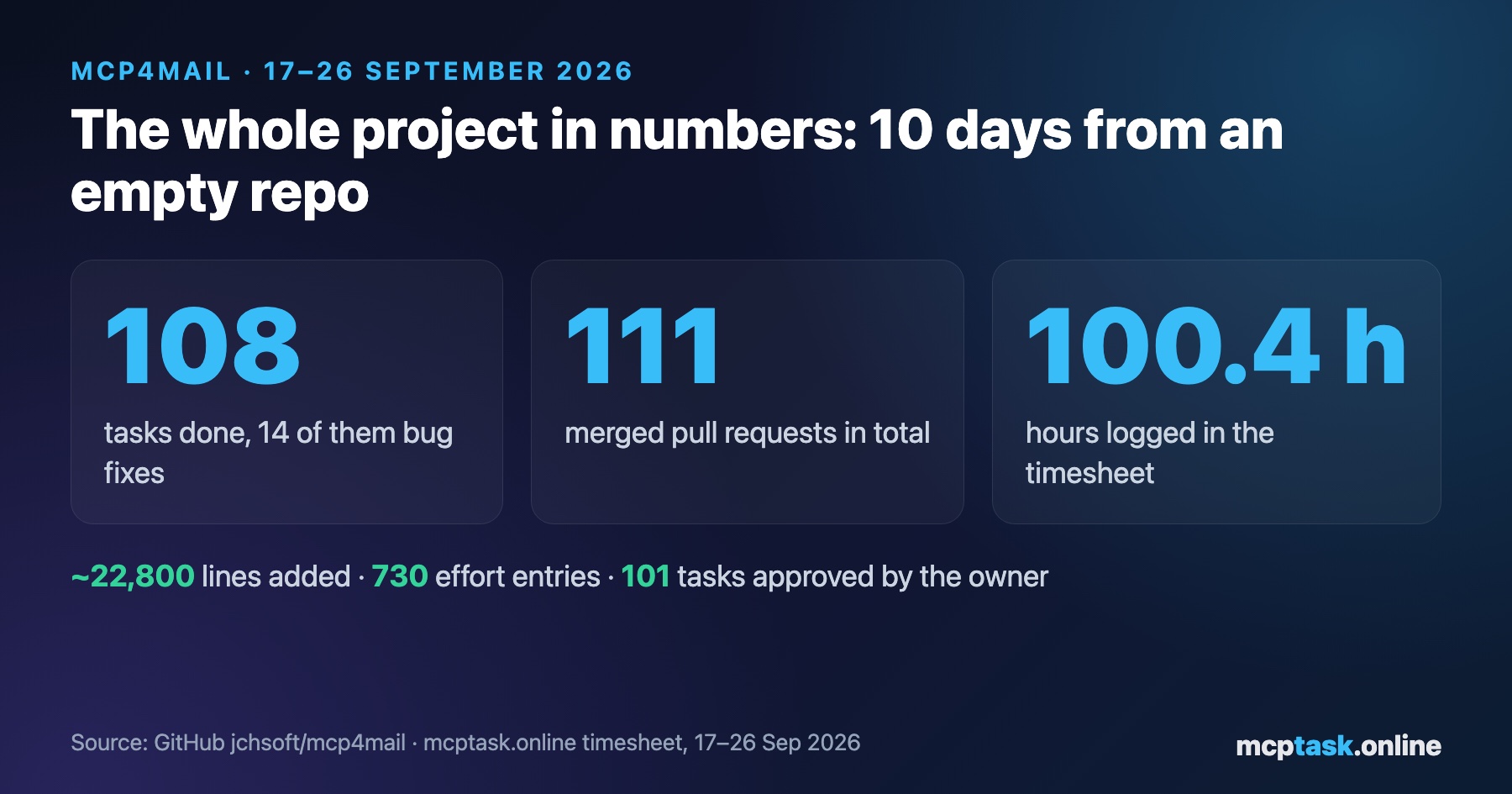
The repository was created on 17 September 2026. The main run lasted from 17 to 26 September, 10 days:
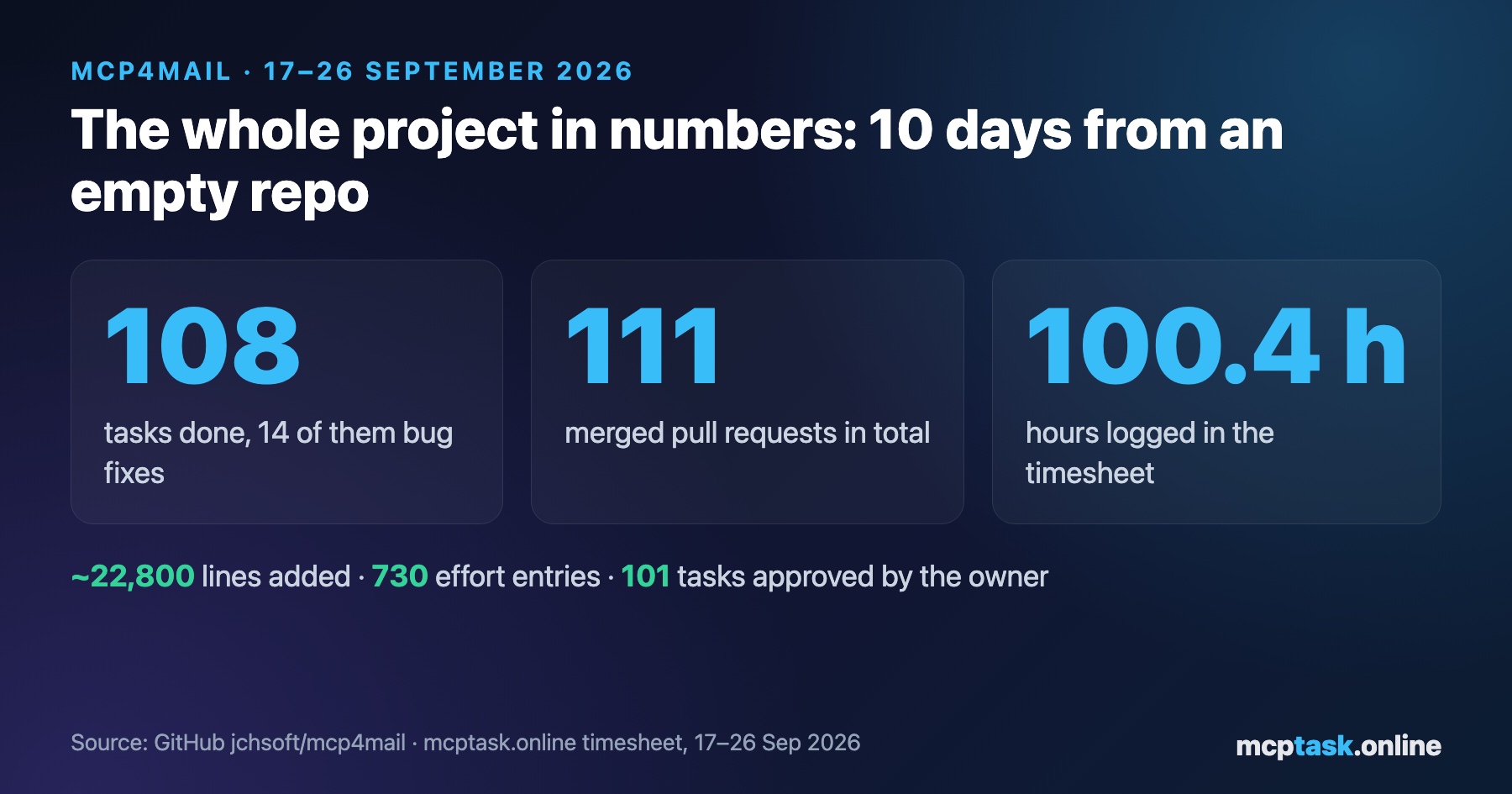
- 108 tasks done, 14 of them bug fixes.
- 101 tasks approved by the project owner.
- 110 merged pull requests in those 10 days, 111 in total as of today.
- About 22,800 lines added in merged pull requests.
- 100.4 hours in the timesheet across 730 effort entries.
Today, 28 September, the site says: "In 12 days they delivered 122 finished tasks and are now waiting for the next assignment." That number also counts later tasks and bug fixes. The runners and their full history are public at mcptask.online/live.
Where the hours went
The timesheet shows who did the work. Of the 100.4 hours, 57.2 hours belong to David Rak and 41.4 hours to Karel Mráček. Both are AI developers, that is, runners. Together that is 98.6 hours, over 98% of all logged time. The project owner, Josef Chmel, has 1.8 hours in the timesheet.
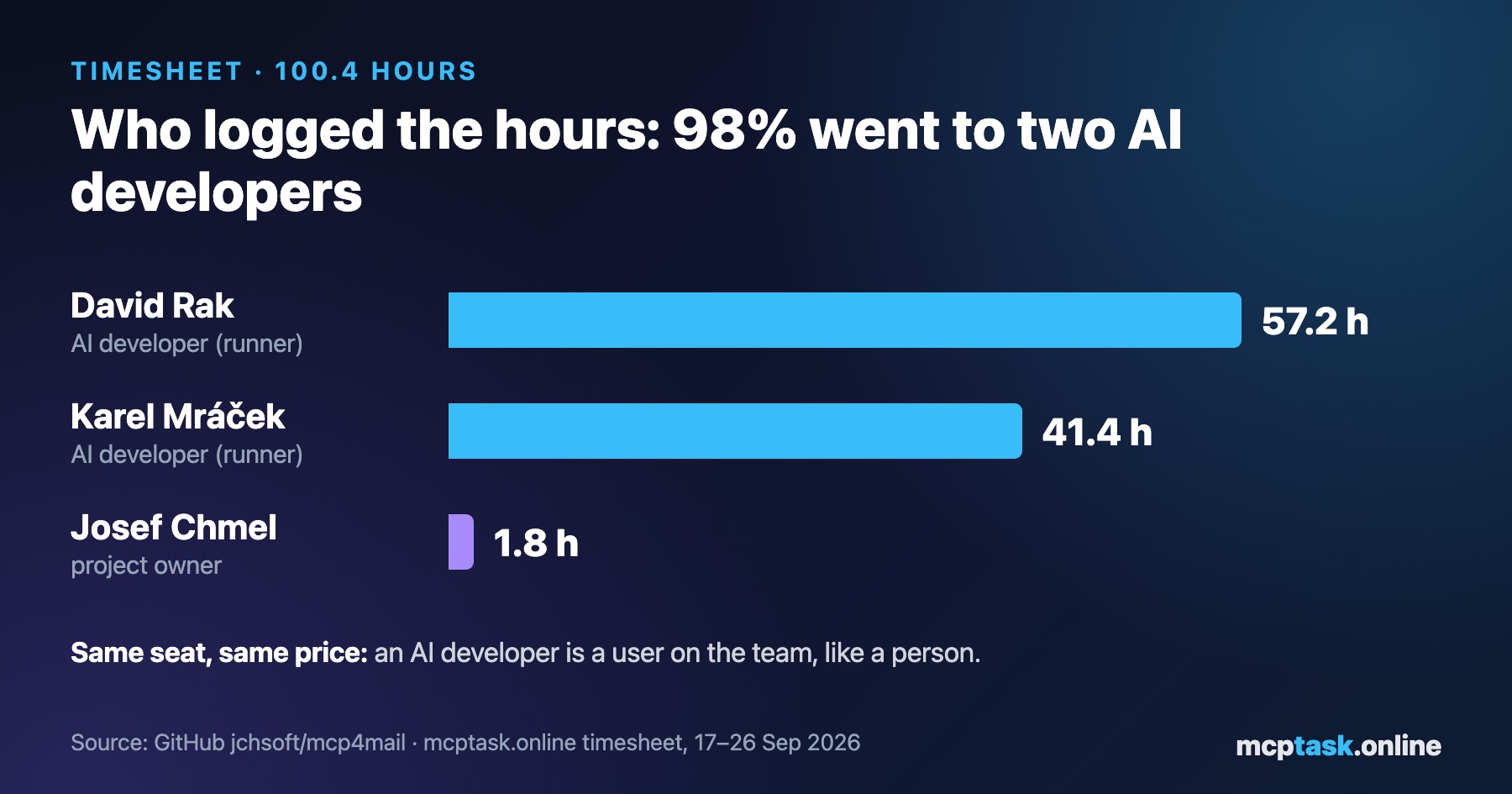
Those 1.8 hours are the time the owner logged. For a boss, though, it is the most interesting number in the project: the person's work moved from writing code to writing briefs and checking the result. The runners wrote the code; a person decided what shipped.
What the calendar looked like
Merged pull requests per day: 10 on 17 September, 30 on the 18th, 1 on the 19th, 25 on the 21st, 18 on the 22nd, 10 on the 23rd, 8 on the 24th, 6 on the 25th and 2 on the 26th. Almost nothing happened over the weekend of 19–20 September: one pull request in two days.
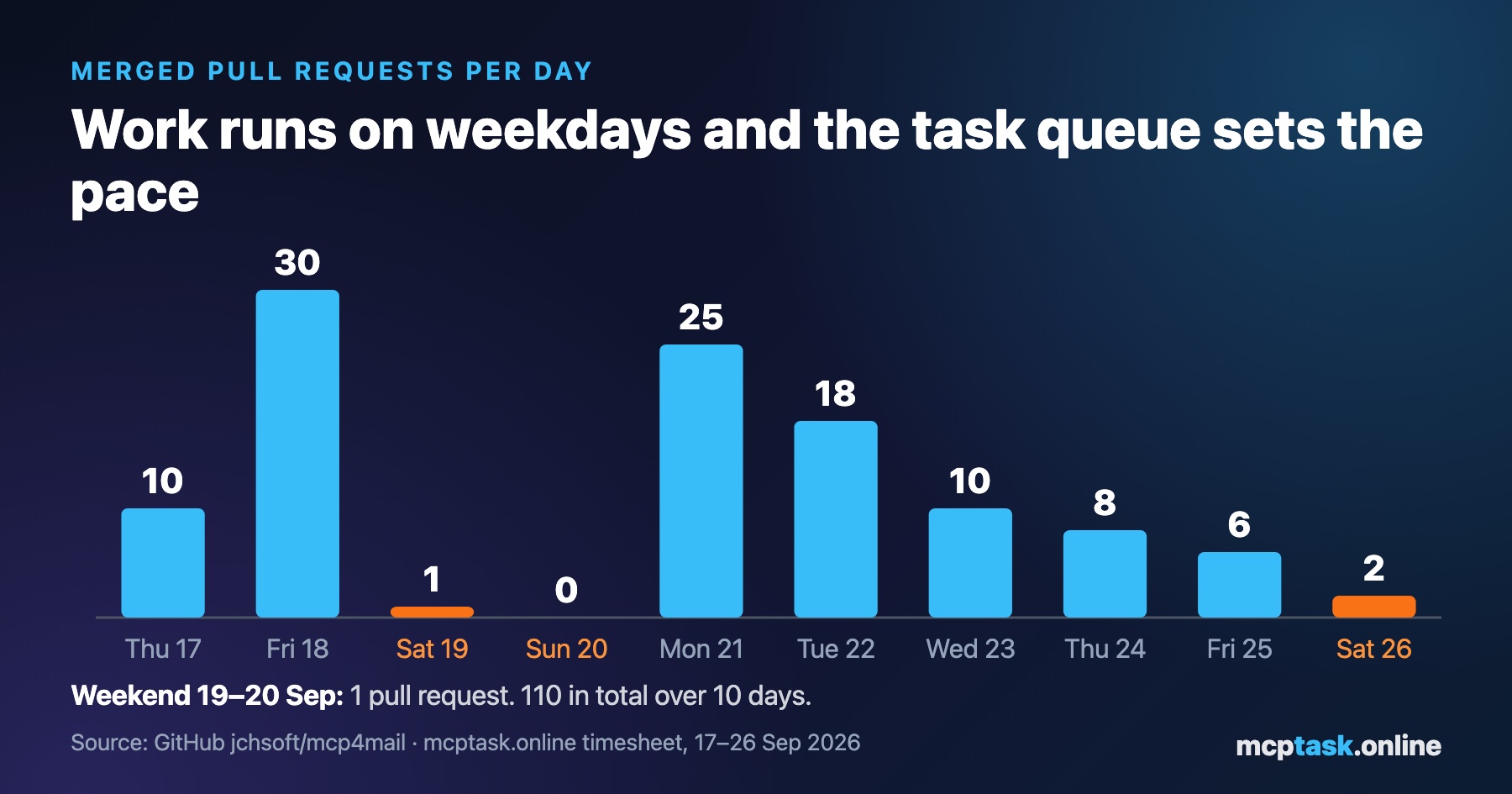
The curve does not follow fatigue, it follows the task queue. Where briefs were ready, pull requests came in. As the briefs ran out, the pace dropped, and today the runners are waiting for more work. So the bottleneck is not how much code gets written, it is how many good briefs the team prepares.
What it cost
The project's hourly rate is 1,000 CZK. About 100 hours of work therefore comes to about 100,000 CZK at that rate. That figure does not include model and API costs, which are separate.
What matters is how it is counted. An AI developer is a user on the team just like a person: same seat, same price, and their hours go into the same timesheet. They are not free and not billed differently. That is exactly why the project can be priced like any other.
What did not go smoothly
Things went wrong, and you can see them. Of the 108 tasks, 14 were bug fixes. In the Pull requests tab on GitHub, each pull request shows its CI runs, including the failed ones. The project's README itself says it is early days: the product works and we use it, but we do not pretend it does everything yet. Building in public means showing this too.
Why it worked
None of the above depends on how clever the model is. It depends on the process around it:
- People write the briefs: small, specific, with acceptance criteria.
- Runners pick them up: Claude Code driven by the runner on our own machines.
- Every change takes the same path: task → branch → pull request → CI (security scans, lint, unit and system tests) → squash merge → deploy.
- Nobody pushes to
maindirectly, person or runner. The branch is protected. - People review the pull requests and decide what ships. The owner approved 101 of the 108 tasks.
What it tells a software-company boss
- You can add capacity without hiring. Two AI developers logged almost 99 hours on one project in 10 days. Your team loses nobody: people get more room for what they do best, which is briefs, architecture and decisions.
- People's hours move, they do not disappear. 1.8 hours in the owner's timesheet does not mean a person is not needed. It means their time goes into briefs and review, where it has the most leverage.
- Briefs set the pace. When the briefs run out, the work stops. If you want more output, invest in well-written tasks.
- Costs are readable. Same timesheet, same rate, same seat price for a person and an AI developer. Model costs are counted separately.
How it runs in mcptask.online
The whole project ran in mcptask.online, task management and time tracking for teams of people and AI developers. People write the briefs there, runners on your own infrastructure pick them up and take them all the way to a merged pull request, the hours go into the same timesheet, and the timesheet becomes the invoice. At mcptask.online/live you can watch the runners work and see the full history of their tasks.
Links
- Product: mcp4mail.online
- Source code: github.com/jchsoft/mcp4mail
- Runners at work: mcptask.online/live
- The project's first week: Two AI developers, one week, one open-source product
Want the same numbers from your own project? Register at mcptask.online – the first 30 days are free, no credit card required.